

Since 2010, Oakland, Berkeley, and San Leandro have joined San Francisco in using ranked-choice voting to elect their mayors and council members. In 2022, Albany adopted at-large multi-winner ranked-choice voting. Here you can see results for all multi-round contests, and try practice polls.
This year features the first 4-seat at-large ranked-choice election in Albany (and California as a whole) for the Board of Education, along with a competitive 2-seat contest for Albany's city council. Berkeley's council district 1 is an open seat, while incumbents in Berkeley's district 8 and several Oakland contests have drawn multiple challengers.
Practice polls — learn about the candidates, and rank them!
- Albany City Council Vote Results
- Albany Board of Education Vote Results
- Berkeley City Council, District 1 Vote Results
- Berkeley City Council, District 8 Vote Results
- Oakland Mayor Vote Results
- Oakland School Director, District 4 Vote Results
- Oakland School Director, District 6 Vote Results
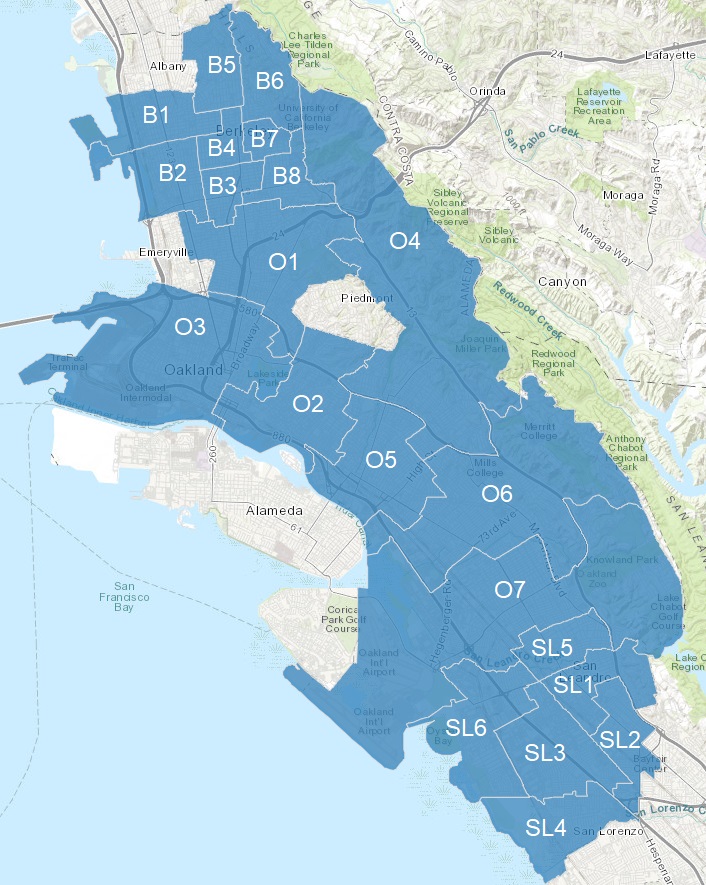
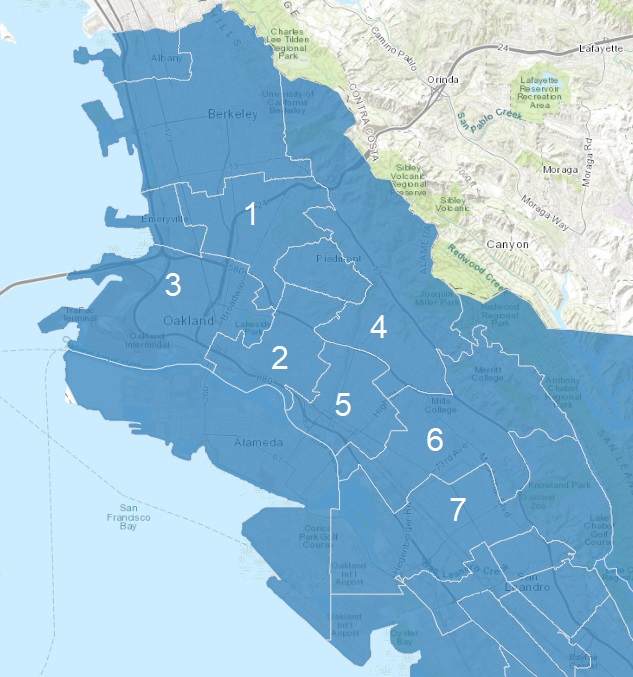
The Sheffield Park neighborhood (SE corner of O7) and most of the Oakland airport (SW corner of O7) are in the City of Oakland, but not in Oakland's school district.
Maps derived from the Alameda County Registrar of Voters.
- 2025, District 2 Results Stats
- 2024, At-Large Results Stats
- 2024, District 3 Results Stats
- 2024, District 7 Results Stats
- 2020, At-Large Results Stats
- 2020, District 3 Results Stats
- 2020, District 7 Results Stats
- 2018, District 4 Results Stats
- 2018, District 6 Results Stats
- 2014, District 2 Results Stats
- 2014, District 6 Results Stats
- 2012, At-Large Results Stats
- 2012, District 1 Results Stats
- 2012, District 3 ** Results Stats
- 2012, District 5 Results Stats
- 2010, District 4 Results Stats
- 2022, District 4 ** Results Stats
- 2022, District 6 Results Stats
- 2020, District 1 Results Stats
- 2020, District 3 Results Stats
- 2020, District 5 Results Stats
- 2020, District 7 Results Stats
- 2016, District 3 Results Stats
- 2016, District 5 ** Results Stats
- 2014, District 4 Results Stats
- 2012, District 3 Results Stats
** indicates contests where a winner overcame a leading first-round candidate in later rounds.
* indicates single-winner contests where a candidate not in the first-round top two reached the final round.
Ranking columns: A ballot limited to 3 choices was used from 2010 to 2018. Machines were upgraded in 2019 to allow up to 10 choices, first used in RCV contests in November 2020, but the county imposed a 5-choice limit through 2025. The 3-choice limit was the subject of a lawsuit in San Francisco that was rejected by both courts. A lawsuit challenging Oakland’s 5-choice limit was settled in 2025. See this analysis of the impact of a 3-choice limit — it is wise to use all available columns and choose lower-ranked candidates who are more likely to survive to later rounds.
There is ongoing community advocacy for more ranking columns. In November 2024, Oakland’s at-large contest had 10 candidates, and the 2025 mayoral contest had 9, but only 5 ranking columns were provided. Oakland’s charter 1105(k)(1) allows fewer rankings than candidates only if “the voting equipment cannot feasibly accommodate” the same number. San Francisco provided 10 ranking columns in its 13-candidate mayoral contest using the same voting equipment. The stats page shows 3,341 voters (2.3%) used all 5 columns but still exhausted. On May 6, 2025, the Oakland City Council pledged to use more ranking columns in the future when necessary.
These results are an independent, unofficial analysis of cast vote records released by the Alameda County Registrar of Voters. Some results differ slightly from those published by the county. The county separates out all “overvotes” (more than one mark per column), whereas DemoChoice treats them as votes for “none of these.” Ballots with first-round overvotes are not counted here. In some years, exhausted ballots in the county’s published results include voters who did not cast a vote in the RCV contest at all. In some single-winner contests, the county has continued eliminations until only one candidate remains; DemoChoice does not do this.
The November 2024 results are from the Dec 3 cast vote record release, which omits ballots from precincts with fewer than 10 votes cast under Elections Code 15250.5. Two precincts in Oakland were omitted, causing 8 missing votes in the at-large contest and 2 in District 7. In November 2022, a misconfiguration in the Registrar’s tally led to a court-ordered change in a certified result for Oakland School Director District 4. The 2018 and 2020 RCV results are not posted on the Registrar’s website; unofficial interpretations are shown here.
In total, 50 multi-round contests are shown here, representing 1,704,448 votes countable in at least the first round from 2010 through 2025.